01 Jul

Have you ever opened a position on a 5-minute or 15-minute chart, watched it move immediately into profit, only to have the market violently reverse and hit your stop loss?
You aren’t a bad trader. You are simply trading the wrong timeframe.
Most retail market participants fail because they are trapped in lower-timeframe market noise. They look for instant gratification, opening short-term structures to make money “right now”. But by ignoring the dominant long-term market trends, they are trying to navigate an entire forest while standing blindly behind a single tree.
To build a sustainable, high-probability approach to the financial markets, you must learn to ignore retail indicators and focus entirely on institutional supply and demand imbalances.
The Danger of Retail Day Trading Timeframes
The logic taught in standard retail trading education is flawed. Beginners are told that bigger timeframes are too expensive or too slow, prompting them to zoom in on 1-hour, 5-minute, or even 1-minute charts.
This creates a massive reliability gap:
- The lower the timeframe, the lower its structural reliability. Intraday trends change multiple times within a single session. A 1-hour chart can flip from bullish to bearish in an afternoon, creating a chaotic environment where emotional decisions thrive.
- The higher the timeframe, the higher its structural reliability. Major weekly and monthly trends take months—sometimes years—to shift. They represent true institutional accumulation and distribution zones.
If a 1-hour chart is dropping aggressively, an uneducated day trader looks to short the market. However, if that drop lands directly into a major weekly demand level, the market will reverse violently. Without the big picture, you will constantly find yourself guessing why a technical setup failed despite “good entry criteria” on your execution screen.
Understanding Institutional Supply and Demand Imbalances
Price moves for one core reason: an imbalance between buyers and sellers. Large institutions, hedge funds, and central banks do not trade using moving averages, retail indicators, or news releases. They trade massive blocks of shares or contracts that leave permanent footprints on high-timeframe charts.
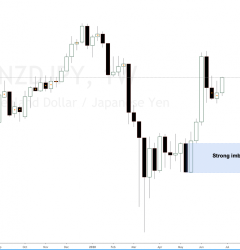
These footprints manifest as imbalances—explosive moves that feature large candlestick bodies and gaps, showing a complete lack of opposing liquidity.
When an institutional demand zone takes control on a monthly or weekly chart, it will easily run over any minor intraday supply levels sitting in its path. Your job is not to predict when or why these imbalances happen. Your job is simply to map where they are and wait for the market to pull back into them.
Forex and Stock Market Case Studies
1. Coca-Cola Consolidated (COKE) & Multi-Timeframe Confluence
Looking at the 1-hour chart of Coca-Cola Consolidated during a sharp bearish correction, an intraday trader might assume a structural breakdown is underway. Yet, zooming out to the weekly chart reveals a strong, fresh weekly demand level in complete control. The moment the asset hits that high-timeframe zone, the bearish impulse stops, reverses, and rallies cleanly. If you ignore the weekly timeframe, you are trading completely blind.
2. NASDAQ Futures (NQ) & The Single-Timeframe GPS Trap
Trading an index like the NASDAQ using a single timeframe is like trying to pinpoint your position on planet earth using only one satellite. A GPS requires a connection to multiple satellites simultaneously to achieve absolute accuracy. Similarly, a rules-based trader utilizes a top-down approach. If the 1-hour chart shows an aggressive supply zone but the monthly chart is sitting in long-term demand, selling is a low-probability trap.
3. Starbucks (SBUX) & The Overextension Rule
Starbucks recently highlighted a clean 4-hour demand imbalance that aligned perfectly with a broader long-bias trend, leading to an explosive multi-day rally. However, once that rally extends directly into a dominant weekly supply zone, the environment shifts. Even if smaller charts look incredibly bullish, entering a long position at the roof of an institutional supply zone violates core risk management rules.
Trade Safely: Stop Asking “Why”
Retail traders spend hours scanning news feeds, earnings reports, and economic calendars trying to decipher market moves. This is an exercise in futility.
Consider an asset like Oracle (ORCL), which recently released positive earnings data and immediately printed a massive bearish sell-off. To the fundamental retail trader, this makes no sense. To a supply and demand analyst, the reason doesn’t matter.
Think of it like driving a vehicle: you do not need to understand every moving mechanical component inside the engine block just to safely navigate the roads. You just need to know how to drive safely according to the signs in front of you. In trading, those signs are fresh imbalances. When a monthly demand zone is in control, you look for buying confirmations; when price is overextended, you stand aside and wait for the pullback.
Defeating Greed and Managing Targets
The final roadblock for retail traders is human psychology. Once you locate high-probability setups by chaining your timeframes correctly, your exit strategy must be entirely objective.
Many traders let greed take control of their positions, holding out for infinite targets because a move looks powerful. This allows the ego to override core rules.
A professional, mechanical approach relies on fixed reward-to-risk ratios:
- Set your stop loss safely past the structural invalidation point of the imbalance.
- Systematically take your profits at fixed intervals—such as $2\times$ or $3\times$ your initial risk ($2R$ or $3R$).
By paying yourself systematically and exiting the market without emotion, you protect your capital from sudden institutional reversals and build a consistent trading business. Stop chasing the noise on the 5-minute charts, climb to the top of the mountain, and let the high-timeframe institutional imbalances dictate your next move.



Ethereum Classic Price Prediction 2026: Is ETC Ready to Rally?
August 21, 2026

Microsoft Stock Analysis — Learn Supply and Demand Trading
August 19, 2026
Walt Disney Stock Analysis: Why It’s a Top Stock to Buy in 2026
August 14, 2026
