11 Jun
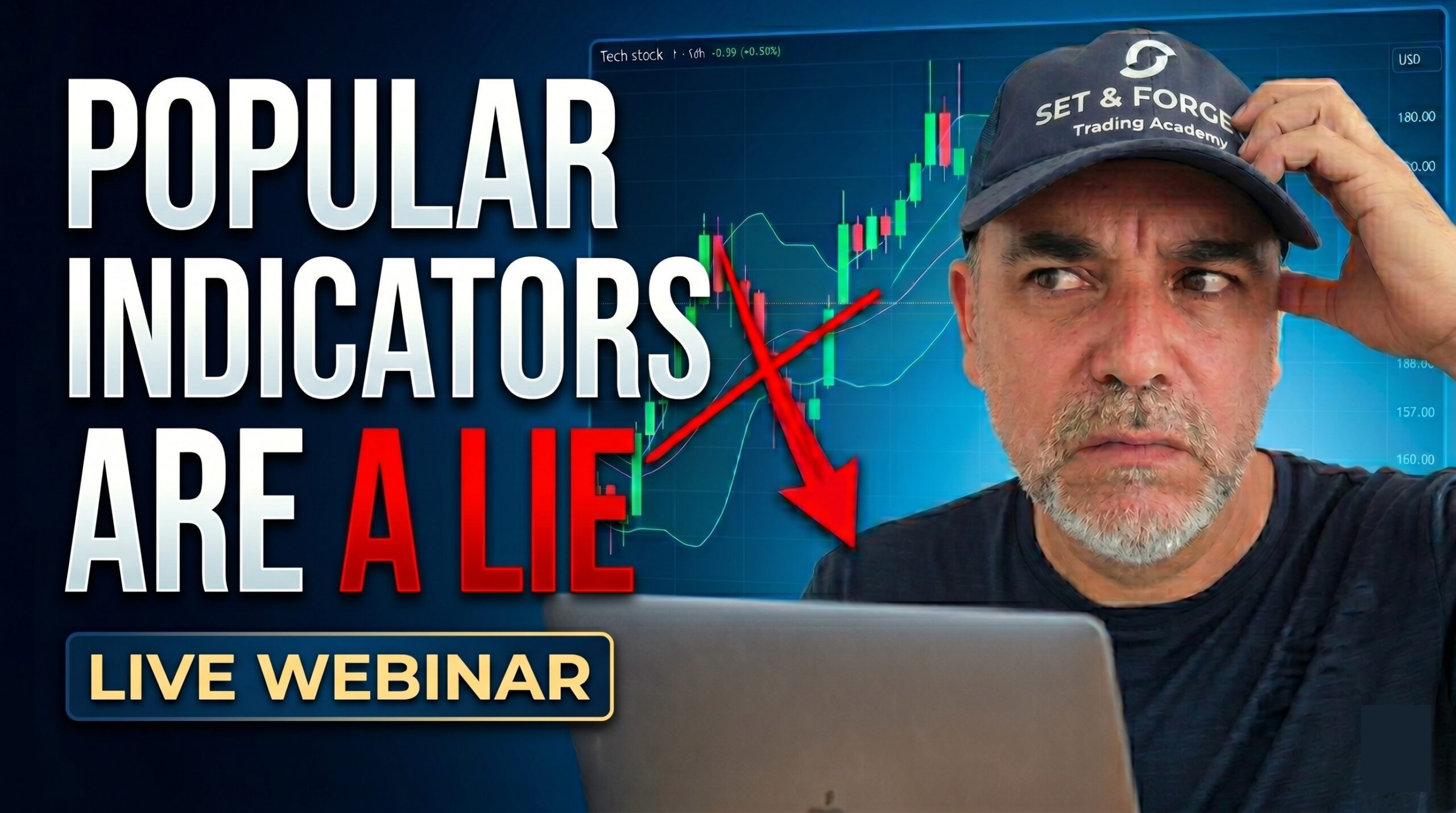
Let’s be honest for a second. If drawing a couple of colourful lines on your chart and waiting for two moving averages to cross like a pair of clumsy star-crossed lovers actually worked, every single person with an internet connection would be sipping champagne on a superyacht in Puerto Banús (Marbella city, where I live) right now.
Instead, most retail traders spend years staring at a screen that looks like a neon disco ball exploded all over it, wondering why their account balance keeps bleeding out.
The harsh reality? Popular technical indicators are a lie.
They don’t tell you where the market is going. They tell you where it just went. If you are trying to learn how to trade stocks or trying to figure out how to make money with stocks by relying solely on lagging mathematical algorithms, you are effectively driving a car down a winding cliffside road while staring exclusively through the rearview mirror.
The Rearview Mirror Fallacy: Why Your Indicators Are Lagging
Let’s look at the math, because numbers don’t have feelings, unlike your trading account after a bad trade.
Whether you swear by the Moving Average Convergence Divergence (MACD), Bollinger Bands, or the Exponential Moving Average (EMA), they all suffer from the exact same structural flaw: these indicators are entirely derivative. They take historical open, close, high, and low data, plug them into a neat little formula, and spit out a pretty line.
Take a look at how messy a daily stock chart becomes the moment you start stacking these retail favourites onto it:
By the time your favourite 50-period and 200-period moving averages finally cross to give you a “golden buy signal,” the smart money—the institutions—have already accumulated their positions weeks ago. They bought at wholesale prices, using and creating demand imbalances. You are buying at the absolute top of the move because your fancy, colourful lines arrived late to the party.
Indicators do not create market moves. Imbalances between buyers and sellers create market moves.
Location, Context, and Framework: The Only Trio That Pays
If you want to survive in this game, you need a rule-based framework built on three pillars: Context, Location, and Execution.
Without a solid supply-and-demand framework, an indicator is just an expensive random-signal generator.
1. Context (The Big Picture)
Before you even think about hitting the buy button on a hot stock like Meta or Disney, you need to know who is actually in control of the market. This requires looking at the higher timeframes—the monthly and weekly charts. If the higher timeframe trend is firmly bearish, trying to buy a minor “oversold” signal on a 1-hour chart is financial suicide.
2. Location (Where the Imbalance Lives)
You don’t just buy a stock because it dropped a few bucks. You buy it because it has pulled back into a high-probability supply and demand zone where banks and financial institutions have left unfilled buy orders.
3. Execution (Your Entry and Risk Management)
This is where price action strategies shine. Once price reaches a major location on a higher timeframe, then you look for a non-lagging entry signal. Can you use a smaller timeframe indicator to help time an entry? Sure, if you want a little extra confirmation. But the location tells you where to trade and, most importantly, where to place your stop-loss to protect your capital.
The Tested Zone Analogy (Or, Why You Don’t Buy Used Goods)
One of the biggest mistakes traders make is going back to the same demand level over and over again, expecting it to hold forever. Let me give you an analogy, and please don’t take offence—it’s just the easiest way to make a point that sticks.
Imagine you are looking for a high-quality, pristine, long-term commitment. You want something untouched, completely solid, and reliable—a “virgin” demand zone that hasn’t been tested yet. The first time price hits that fresh level, the reaction is powerful and beautiful because the institutional buy orders are sitting there waiting.
But what happens when price returns to that exact same zone for the second, third, or fourth time?
All those fresh buy orders have already been filled and eaten away. The zone has lost its strength. The trend is probably changing and the imbalance is under attack. Yet, retail traders look at the chart, see the old level, and say, “Oh, it looks just like it did last year, I’m going to buy it again!”
No, my friend. It is not the same. Time has passed, the order flow has probably dried up, and if you blindly buy into a heavily tested level without an updated uptrend, you are marrying a setup that is ready to leave you broke.
Trade What You See, Not What You Hope
If you want to master how to trade stocks effectively, you have to clean up your charts. The clearer your screen looks, the sharper your trading decisions will be.
| Traditional Indicator Trading | Institutional Price Action Trading |
| Focuses on lagging mathematical formulas | Focuses on raw, non-lagging candlesticks |
| Chases lagging crossover signals | Enters via precise, low-risk supply & demand imbalances |
| Results in wide, arbitrary stop-losses | Utilizes clear, structural risk management levels |
| Hides price action behind colorful lines | Reveals institutional order flow clearly |
The next time a guru on YouTube tries to sell you a “Super-Trend Multi-Oscillator Holy Grail” strategy with 15 different arrows pointing all over the screen, do yourself a huge financial favour: close the tab.
Stop staring at the rearview mirror, learn to look out the front windshield through raw price action, and only take trades where the market structure gives you a mathematical edge.




Tesla Optimus Robot: The Doom of Humanity or Your Next Big Win?
September 18, 2026


Why You’re Trading the Wrong Timeframe (And Why You’re Still Broke)
September 7, 2026
Ethereum Classic Price Prediction 2026: Is ETC Ready to Rally?
August 21, 2026