02 Oct
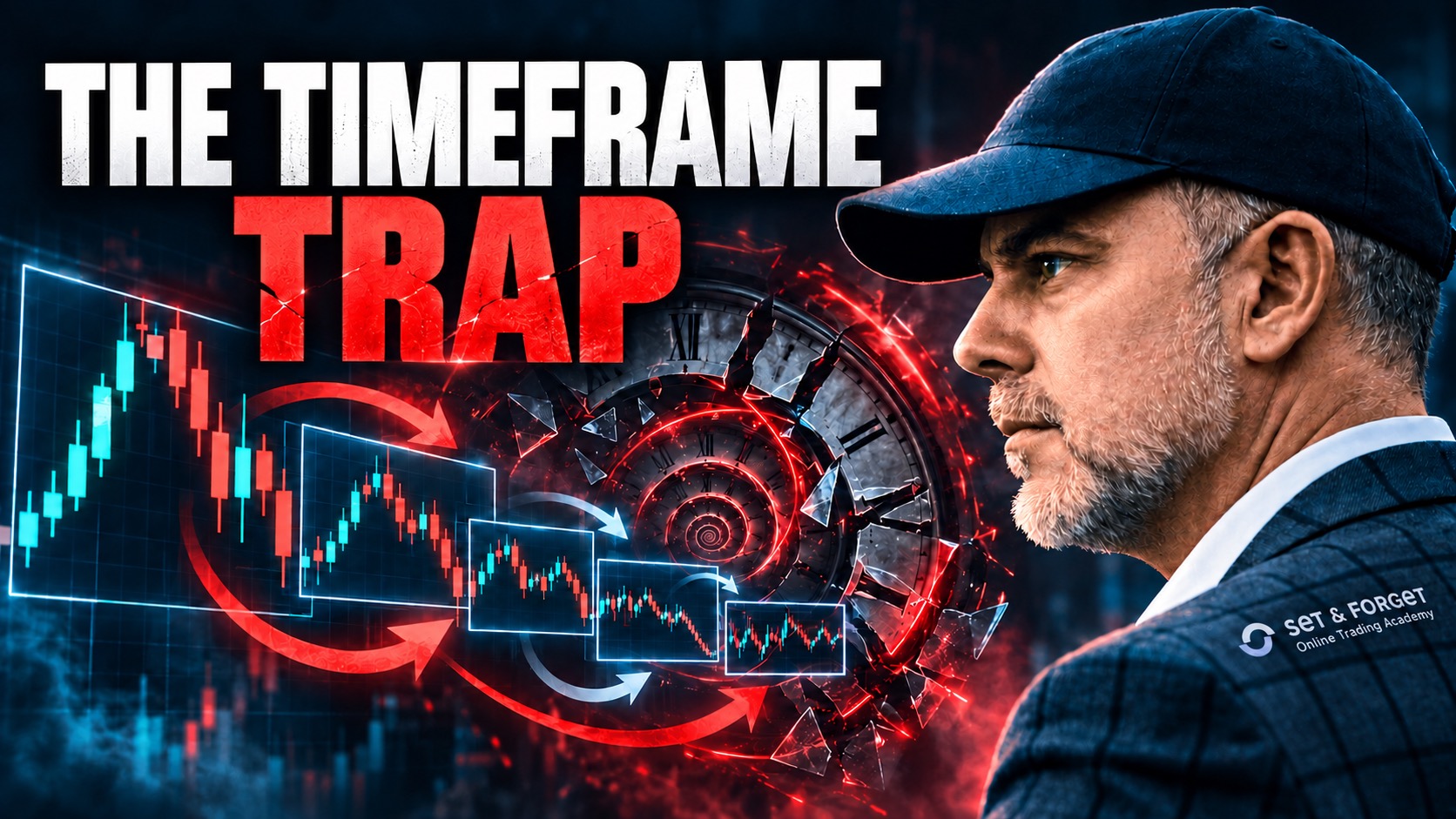
In modern financial markets, the biggest threat to a trader’s capital isn’t a lack of technical indicators—it’s the Timeframe Trap.
Traders frequently drop down to 1-minute, 5-minute, or 15-minute charts searching for lower-risk entries, only to get chopped up by market noise, spread friction, and high-frequency volatility. Without a high-timeframe bias to guide directional bias, scalping low-timeframe charts is the financial equivalent of driving a high-performance sports car down a dark highway at maximum speed without headlights.
Understanding market psychology, the gravity of higher-timeframe imbalances, and proper multi-timeframe alignment turns low-timeframe chaos into institutional precision.
What is the Timeframe Trap?
The Timeframe Trap occurs when a trader relies strictly on lower timeframes (LTF) for trade generation while completely ignoring higher-timeframe (HTF) market structure, location, and key supply or demand zones.
When you focus exclusively on lower timeframes:
- Market structure shifts rapidly: Trends appear to flip every few minutes, causing trade bias confusion.
- False breakout rates skyrocket: LTF support and resistance levels break easily because they lack institutional weight.
- Emotions replace strategy: Rapid price movements trigger FOMO (Fear of Missing Out), revenge trading, and premature exits.
Higher Timeframe (HTF) = Context & Bias Monthly, Weekly, and Daily Supply/Demand Imbalances dictate where major institutional money is positioned.
When you focus exclusively on lower timeframes:
- Market structure shifts rapidly: Trends appear to flip every few minutes, causing trade bias confusion.
- False breakout rates skyrocket: LTF support and resistance levels break easily because they lack institutional weight.
- Emotions replace strategy: Rapid price movements trigger FOMO (Fear of Missing Out), revenge trading, and premature exits.
Market Gravity: Why Higher Timeframes Control Price
Financial markets are moved by institutional order flow, central bank allocations, and large-scale liquidity pools. These major entities operate primarily on Monthly, Weekly, and Daily charts.
When a major supply or demand imbalance forms on a weekly or monthly chart, it acts like a gravitational core. Regardless of what a 5-minute chart does in the short term, price is continuously pulled toward these higher-timeframe imbalances to fill unfilled institutional orders.
The Concentric Target Model
Think of timeframes as target zones in professional archery:
- Outer Ring (Monthly & Weekly Zones): High-probability zones with the largest institutional weight.
- Middle Ring (Daily & 4-Hour Context): Medium-probability zones that confirm directional movement.
- Centre Bullseye (1-Min & 5-Min Execution): Microscopic target areas—extremely difficult to hit consistently over hundreds of trades without outer-ring alignment.
Attempting to hit the microscopic centre every single trade without aligning with the outer rings leads to rapid account depletion.
Multi-Timeframe Alignment: Framework for Consistency
To trade supply and demand successfully across Forex, stock indices, commodities, and cryptocurrencies, implement a rigid top-down analysis model.
| Analysis Step | Timeframe Range | Strategic Purpose |
| 1. Directional Bias | Monthly & Weekly | Identifies major institutional imbalances and establishes whether you are Long Only or Short Only. |
| 2. Tactical Context | Daily & 4-Hour | Confirms structure alignment and checks if price is reaching key reaction zones. |
| 3. Precision Execution | 15-Min & Lower | Serves purely as an execution trigger for fine-tuning entry location and managing trade risk. |
How to Cure Lower-Timeframe Addiction
- Trade Context First, Entry Second: A pristine 5-minute entry setup inside a HTF dead zone is a low-probability trade.
- Accept Loss Prevention over Trade Frequency: High-frequency scalping increases broker commission costs and exposure to slippage.
- Control Emotion Through Rules: Define your risk parameters, stop-loss location, and target before placing the order.
- Never Fight Market Gravity: Never take a low-timeframe short directly into a higher-timeframe demand level, regardless of how bearish the short-term momentum looks.
By anchoring your analysis in high-timeframe supply and demand imbalances, you remove emotional noise, protect your equity, and trade in alignment with institutional order flow.


Support & Resistance vs. Supply & Demand: Why You Are Trading Wrong
September 25, 2026
Tesla Optimus Robot: The Doom of Humanity or Your Next Big Win?
September 18, 2026
