09 Apr
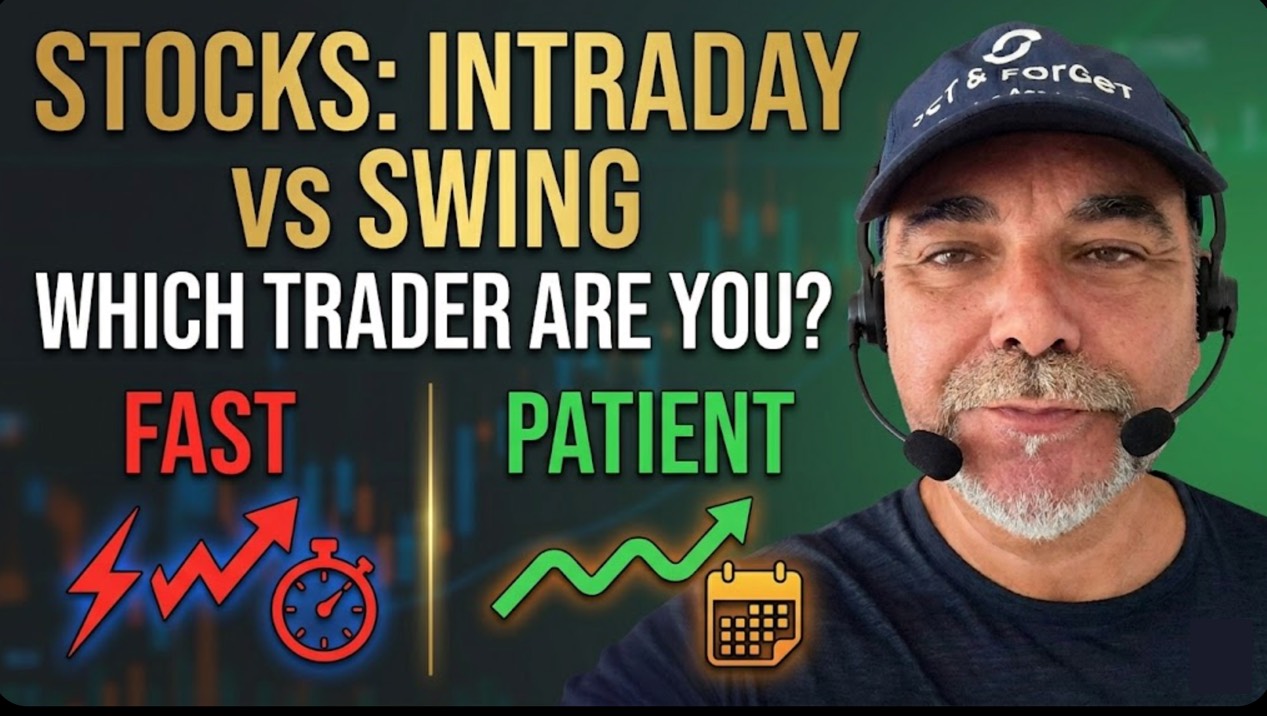
If you want to learn to trade stocks, one of the first decisions you’ll face is whether to focus on intraday trading in stocks or move towards swing trading strategies. Most traders think this is a matter of personality or time availability, but the real difference runs much deeper than that.
The truth is that most traders fail, not because they chose the wrong style, but because they are looking at the market in the wrong way. They focus on short-term price movements without understanding what is actually driving those movements. And that’s where everything starts to break down.
In this article, I’m going to show you how price action trading, combined with supply and demand imbalances, completely changes the way you approach both intraday and swing trading in stocks.
Why Most Intraday Trading in Stocks Fails
Intraday trading is often sold as the fastest way to make money in the stock market. The idea of opening and closing trades within minutes or hours sounds appealing, especially if you’re looking for quick results.
But here’s the problem.
Most intraday traders are operating in an environment dominated by noise. They are watching small timeframes like the 1-minute or 5-minute charts, trying to predict every minor fluctuation in price. What they don’t realize is that these movements are often random unless they are aligned with a much bigger picture.
Institutions, which are the real drivers of the market, are not making decisions based on those small fluctuations. They are positioning themselves based on higher timeframe supply and demand zones, often visible on the daily, weekly, or even monthly charts.
So when a retail trader tries to go long on a 5-minute breakout, they are often buying directly into a higher timeframe supply level without even knowing it. That’s why so many intraday strategies feel like they work… until they suddenly don’t.
Swing Trading in Stocks: Following the Real Money
Swing trading operates on a completely different logic. Instead of trying to capture every small move, it focuses on identifying high-probability price zones where institutions are likely to step in.
When you start analyzing stocks using multi-timeframe analysis, something interesting happens. You begin to see that price doesn’t move randomly. It moves from one imbalance to another.
For example, when analyzing stocks like BlackRock (BLK), you can clearly see how price reacts to demand levels created weeks or even months before. These are not accidental reactions. They are the result of institutional positioning.
The same logic applies to stocks like Chevron Corporation (CVX), where larger timeframe supply levels can completely override short-term bullish momentum. Traders who focus only on intraday charts will often get trapped buying into those areas, while swing traders are waiting for price to reach those zones to take the opposite side.
This is why swing trading is not slower trading. It is simply trading with a better context.
The Role of Supply and Demand in Stock Trading
If you strip away all indicators, all news, and all opinions, what you’re left with is price. And price moves because of an imbalance between buyers and sellers.
That’s what supply and demand trading is all about.
When demand is greater than supply, price moves up. When supply overwhelms demand, price drops. It sounds simple, but most traders completely ignore this reality when they start looking at charts.
Instead, they rely on indicators, patterns, or news events, hoping those tools will give them an edge. But the reality is that those tools are just derivatives of price. They lag behind what is actually happening.
Understanding price action in stocks means understanding where the big players are likely to buy and sell. And those decisions are not made on a 5-minute chart.
The Wine Analogy: Why Traders Buy at the Worst Time
Let me put it in a way that makes it impossible to forget.
Imagine you walk into a restaurant and see a bottle of wine that normally costs €4 being sold for €50. You wouldn’t buy it. You’d immediately recognize that it’s overpriced.
Now imagine that same bottle drops back to €6. Suddenly, it feels cheap again.
This is exactly how the market works.
But when traders look at charts, they forget this basic logic. They see price going up and assume it will keep going up. They buy when the market is expensive and hesitate when it’s cheap.
This is why most traders struggle with both intraday trading and swing trading. It’s not the strategy. It’s the perception of value.
Intraday vs Swing Stocks Trading: Which One Should You Choose?
The answer is not as black and white as most people think.
If you understand higher timeframe supply and demand, you can actually combine both approaches to trade stocks. You can identify a long-term demand level on the weekly chart and then use intraday charts to refine your entries.
But if you ignore the bigger picture and focus only on intraday setups, you are essentially trading blind.
For most traders, especially those who have jobs or limited time, swing trading offers a much more realistic and consistent approach. It allows you to align yourself with institutional flows instead of fighting against them.
Intraday trading can still be used, but only as a tool within a larger context, not as a standalone strategy.
Real Market Examples: What Actually Moves Stocks
In the webinar, I analyzed several stocks, including Flutter Entertainment (FLUT) and Under Armour (UAA), showing how price reacts to higher timeframe levels.
In the case of Flutter Entertainment, a long-term demand level on the 12-month timeframe created the potential for a significant move higher. That kind of opportunity is invisible if you’re only looking at intraday charts.
With Under Armour, the focus was on long-term positioning around key demand levels, where the potential upside far outweighed the risk. These are the types of opportunities that swing trading is designed to capture.
They require patience, but they also provide clarity.
Final Thoughts: Learn to Trade Stocks the Right Way
If you want to learn to trade stocks, you need to stop thinking in terms of speed and start thinking in terms of context.
Intraday stock trading is not the problem. Swing trading is not the solution. The real edge comes from understanding how the market actually moves.
That means focusing on price action, identifying supply and demand imbalances, and always starting your analysis from the higher timeframes.
Because at the end of the day, the market doesn’t care about your timeframe. But it always respects where the real orders are sitting.


Support & Resistance vs. Supply & Demand: Why You Are Trading Wrong
September 25, 2026
Tesla Optimus Robot: The Doom of Humanity or Your Next Big Win?
September 18, 2026
